Riley, Star, Rasson — Who Supplies What and Under Which Contract
Three manufacturers divide the WST calendar between them, and the differences between their tables are not cosmetic.

Riley, Star and Rasson tables all appear on the ranking calendar, under different supply arrangements.
The Split and What It Means
Professional snooker runs on a single set of rules applied across tables that are not, in practice, identical. Riley Leisure, Star Billiards and Rasson each hold supply arrangements with the World Snooker Tour, and between them they cover the ranking-event calendar from Sheffield to Saudi Arabia. The existence of multiple approved suppliers is a matter of tournament logistics and commercial negotiation rather than any WST preference for variety — but the practical consequence is that players move between tables with subtly different characteristics across the same season.
Riley, the British manufacturer with the longest association with the professional game, supplies the tables at the World Championship at the Crucible Theatre in Sheffield. That relationship has roots in the sport's domestic history: Riley was producing full-size tables long before the game became a television property. At the Crucible, their tables sit beneath Hainsworth or Strachan 6811 cloth, levelled to the sub-millimetre tolerances demanded by Italian slate beds milled in three sections. The table at the World Championship is, in this sense, a composite product — Riley frame, third-party cloth, a specific grade of slate — and the quality control over that combination is the reason the Crucible's tables are considered a benchmark.

A tournament bed is levelled with shims on site over most of a day, and levelled again if a ball drifts.
Photo: Ketut Subiyanto / PexelsStar Billiards, a Chinese manufacturer, has grown substantially on the tour as the sport's centre of gravity has shifted east. Star tables appear at several of the China-based and Asian-market events that now occupy a significant portion of the WST calendar. The company's rise tracks directly with the expansion of professional snooker into markets where domestic manufacturing has a commercial and logistical advantage over shipping British-made equipment. Star tables meet the WPBSA's equipment specifications, and the governing body publishes those standards as part of its tournament licensing conditions.
Rasson, a Belgian manufacturer, has built its professional presence largely through the European market. Their tables appear at a number of ranking and invitational events held outside the UK and China, and the company has also supplied tables for exhibition and emerging-market events. Rasson positions its products at the top of the commercial market, and the spec of their tournament tables — cushion construction, slate grade, cloth compatibility — aligns with what WST licensing requires.
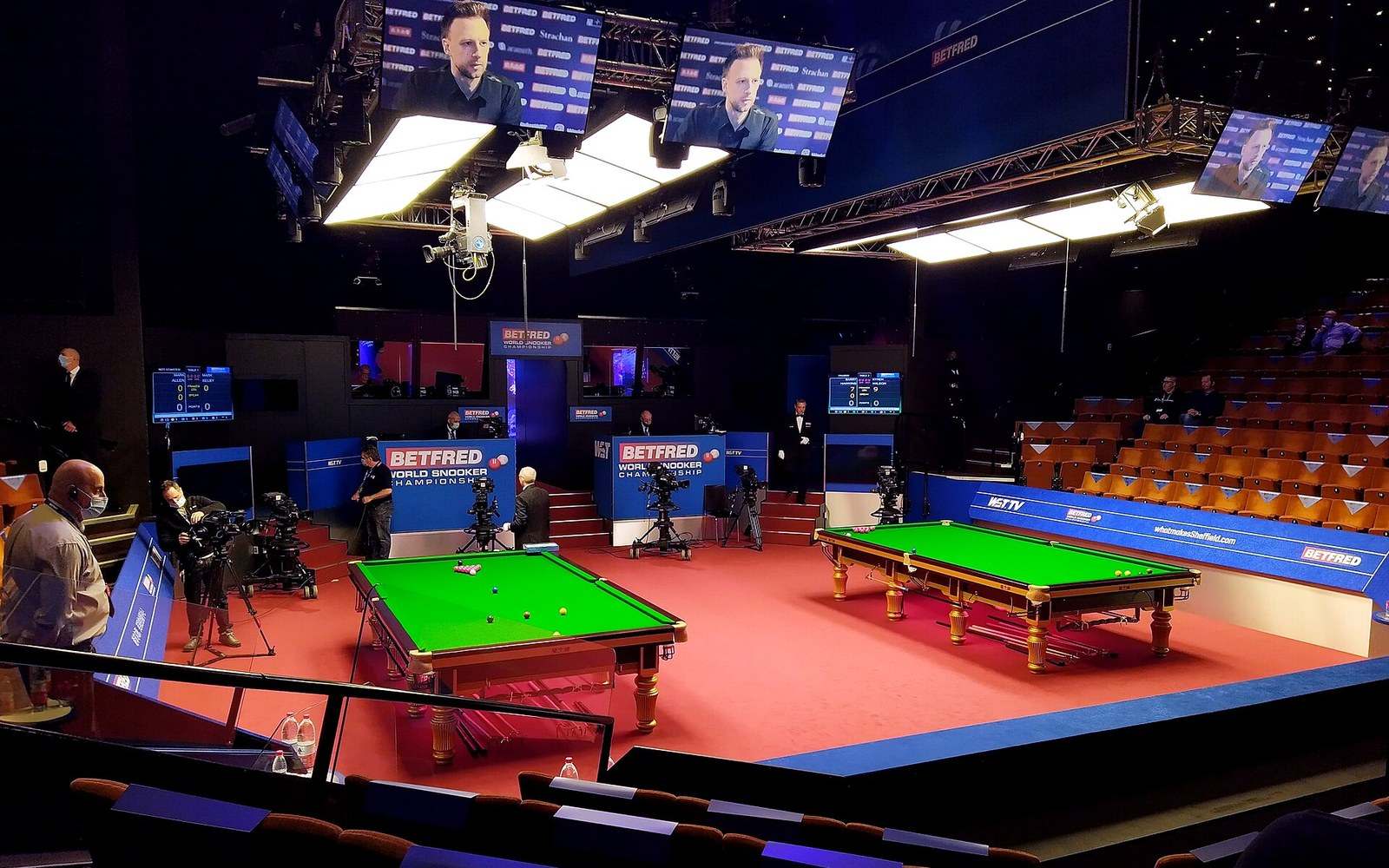
Two tables, a divider between them until the quarter-finals, and 980 seats around them.
Photo: 2021 World Snooker Championship table setup · Wikimedia CommonsWhat the Contracts Actually Govern
The supply arrangements between table manufacturers and the WST are not uniform sponsorship deals. They are closer to licensing and equipment-approval frameworks, in which a manufacturer certifies that their tables meet the WPBSA technical specifications for cushion rebound, pocket dimensions, cloth weight and slate flatness, and in return receives the commercial visibility of appearing at televised events. Tournament promoters — which increasingly means Matchroom Sport operating under WST — then contract directly with whichever approved supplier they choose for a given event.
The practical implication for players is that cushion response and cloth speed can vary meaningfully between manufacturers even when all tables are within specification. Professionals have noted publicly that tables can play differently across the calendar without any table being technically non-compliant. The tolerances built into the specifications are wide enough that a ball struck at medium pace can behave differently off a Riley cushion than a Rasson one. This is not a flaw in the approval system; it is an inherent consequence of multiple suppliers operating to the same written standard with different construction methods.
No single manufacturer holds an exclusive WST contract across all ranking events, and there is no public indication that the tour is moving toward standardisation on a single supplier. The commercial logic runs the other way: as the event count has grown — broadly tripled under the arrangements that followed Barry Hearn's involvement from 2010 — so has the number of host venues and markets, each with its own procurement logic. Three approved manufacturers serving a global calendar is, from the tour's operational perspective, more resilient than one.