Three-Quarters of a Tonne of Italian Slate, and Everything Else Is Arranged Around It
The table that appears on television is the end of a two-day job. What it took to get there is the part nobody films.
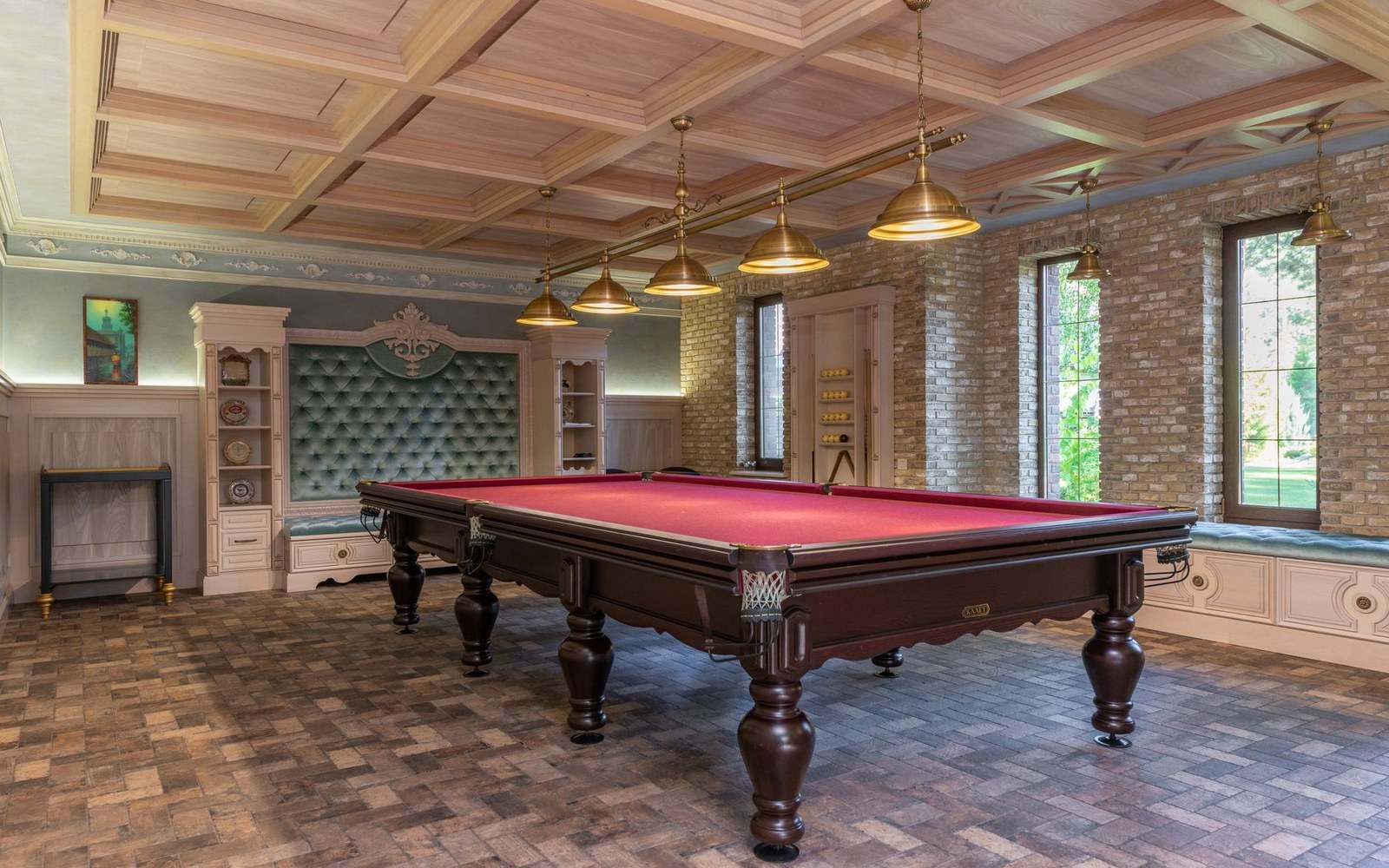
The bed arrives in three pieces because nobody can lift it in one, then it is bolted, shimmed and checked flat to within a fingernail.
Photo: Max Vakhtbovych / PexelsThe Object Itself
A full-size snooker table measures twelve feet by six — 3,569 millimetres by 1,778 millimetres to the playing surface — and at competition specification it weighs somewhere close to 750 kilograms. Most of that weight is stone. The bed arrives in three sections of Italian slate, quarried primarily from the region around Lardello in Tuscany, chosen for a density and uniformity of grain that other natural materials have never quite matched. Each slab is roughly an inch and a quarter thick, ground flat at the quarry to tolerances that the fitter will then refine still further on site. Together they account for the bulk of the table's mass and, more importantly, all of its authority. The rails, the pockets, the cushion rubber, the cloth — they are dressing. The slate is the table.
The frame that receives the slate is typically hardwood or a steel-braced equivalent, and it sits on adjustable legs whose feet are the first thing a professional fitter reaches for. The floor of an arena is never flat. The floor of a hotel ballroom used for a ranking event is never flat. The floor under the Crucible Theatre's stage, constructed and deconstructed every April, is never flat. Levelling the frame is where the job begins, and it is done with a machinist's spirit level accurate to a fraction of a millimetre per metre, traversed repeatedly across every axis before the slate goes on.

A tournament bed is levelled with shims on site over most of a day, and levelled again if a ball drifts.
Photo: Ketut Subiyanto / PexelsThe Fit and the Feel
Shimming — the insertion of thin packing pieces between slate and frame — is the least glamorous and most critical part of the build. A shim might be a strip of metal, a sliver of wood, a piece of plastic. Its purpose is to correct for any warp or sag in the frame after the weight of the slate settles. Fitters work section by section, checking each slab independently, then checking all three together. The join between sections is then filled with beeswax, worked into the seam and levelled by hand until a coin dragged across the surface encounters no perceptible ridge. At ranking-event standard, the tolerance across the full length of the bed is typically stated as within a thickness roughly equivalent to a thumbnail — around half a millimetre from one end to the other. Given that the balls themselves are 52.5 millimetres in diameter and manufactured by Saluc's Aramith process to within a hundredth of a millimetre, any greater deviation in the bed would be measurable in play.
The cushion rails are fitted next, carrying the rubber profile — the precise angle and density of which governs the rebound angle a player can calculate and trust. Competition-grade rubber is pre-formed to a specification the major manufacturers hold tight; it ages and hardens over years, and tables that see heavy play are re-cushioned on a cycle the tournament contractor tracks. What the spectator sees as a simple bounce off the cushion is the product of a rubber compound, a precise nailing pattern into the rail, and the cloth covering that rubber — all three variables in play every time a ball meets the rail.

The nap runs from baulk to the top cushion, so the same shot plays differently in each direction.
Photo: Pavel Danilyuk / PexelsThe cloth comes last, and it is where the table acquires its character. At most WST ranking events, the specification is Strachan 6811, a worsted cloth woven to a weight and nap direction that the professional game has treated as near-standard for decades. The roll arrives on site pre-cut, and the fitter stretches it over the bed in a single piece, pulling tension evenly from end to end before stapling into the underside of the slate bed's perimeter. It is then drawn up over the cushions and fixed. The nap — the directional pile of the weave — runs from the baulk end toward the top cushion, and every fitter knows that the whole exercise has been wasted if that direction is reversed. A ball rolling with the nap behaves differently from a ball rolling against it; a professional playing the wrong cloth for five minutes will tell you the difference before you can.
The Final Pass
Before any ranking event, the cloth is ironed. This is not metaphorical — a table iron, heated to a specific temperature, is run across the entire surface in smooth strokes that flatten any fibres raised by the stretching process and settle the nap uniformly. Then it is brushed, with a long-handled nap brush drawn always from baulk toward top, to raise the pile consistently. Then it is ironed again. Then brushed again. A fitter working to ranking-event specification will make this circuit more than once before signing off, and the table will be brushed again by the venue staff each morning of play before the first session.
Some professionals apply Taom chalk precisely because its lower residue deposit reduces the degree to which blue chalk dust accumulates on the cloth during a session. A cloth that has absorbed several frames' worth of standard chalk shows it — blue scuff marks around the spots and along the lines of common approach angles. Taom's formulation leaves less of that behind, which matters to fitters and referees as well as players; a cleaner cloth plays more consistently across a session's duration.
The spots are placed by template once the cloth is dressed — the pink spot, the black spot, the brown, the blue, the yellow, the green — each pressed through the cloth into a small indentation in the slate beneath, so the marker does not sit proud of the surface. The table is then draped with a cover and left undisturbed.
What lifts into position in front of the cameras weighs what it weighs and does what it does because two people spent most of two days making it so. The slate neither knows nor cares about any of this. It simply holds the line — which is, in the end, the only thing asked of it.