Ding Junhui Was the First, and the Tour Took a Decade to Catch Up With Him
He won the UK Championship at eighteen, and the sport's commercial relationship with China effectively began the moment he potted the final ball.

A UK Championship at nineteen, and the audience that arrived with it.
Photo: Tima Miroshnichenko / PexelsThe Arrival
Ding Junhui turned professional in 2003, aged sixteen, after winning the World Snooker Under-21 Championship. He was not the first Chinese player to hold a tour card, but he was the first to arrive with the game already fully formed — the cue action, the temperament, the break-building fluency that would produce more than 150 competitive century breaks in his first decade on tour. The professional circuit he joined was still primarily a British television product, scheduled around BBC scheduling blocks, staged almost entirely in UK venues, and watched by a demographic that had changed very little since the 1980s boom.
That context matters because what happened in November 2005 was not just a result. At the UK Championship in Telford, the eighteen-year-old Ding Junhui defeated Steve Davis in the final, 10–6. Davis was then forty-eight and no longer at his peak, but he remained the sport's most recognisable establishment figure, the player who had made the ranking-event circuit credible in the first place. The symbolism was exact: a teenager from Yixing had walked into the sport's second-largest ranking event and beaten its patriarch in the final. In the UK, it was a good story. In China, it was a broadcast phenomenon.
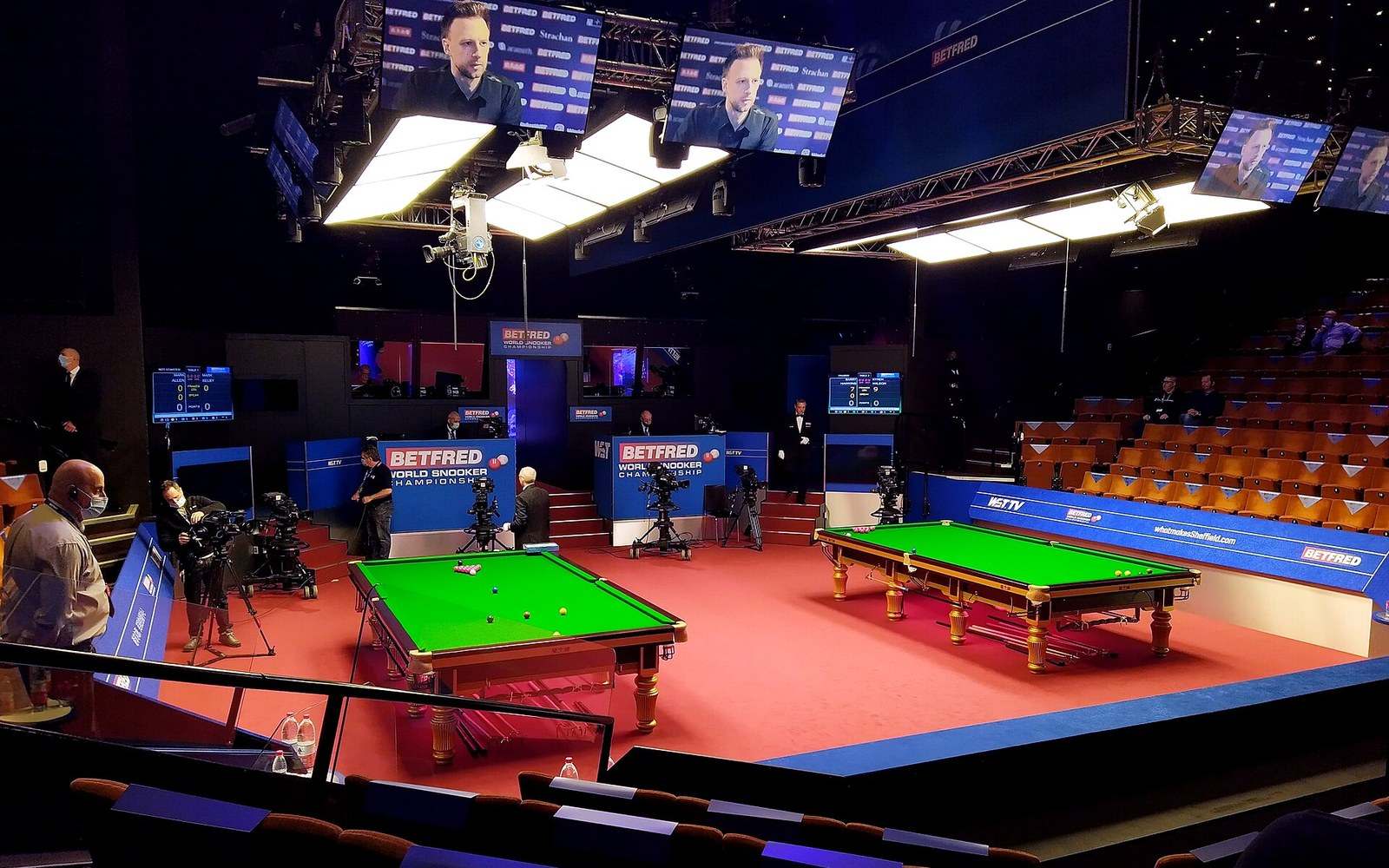
Two tables, a divider between them until the quarter-finals, and 980 seats around them.
Photo: 2021 World Snooker Championship table setup · Wikimedia CommonsThe Bridge
What Ding represented, commercially and structurally, was legibility. CCTV's coverage of the match reached an audience the World Snooker Tour had no other mechanism to address — a viewing public that was enormous, sports-literate and almost entirely unattached to any of the British players and British venues that gave the tour its existing shape. Ding was not a curiosity imported into that world; he was someone that audience had grown up watching, whose trajectory through Chinese amateur competition they already knew. He made the sport make sense to them, not the other way around.
The tour's response was slow but eventually structural. The World Snooker Tour began scheduling ranking events in China within years of Ding's breakthrough, and by the 2010s — under Barry Hearn's Matchroom operation, which took over from 2010 — the Chinese leg of the calendar had expanded to include multiple ranking events in Shanghai, Beijing and elsewhere. Prize funds grew alongside that expansion. None of that is solely attributable to one player, but Ding was the original proof of concept: a Chinese player, playing at the highest level, drawing a Chinese audience, and making the broadcast rights economically meaningful to Chinese television partners.

The world trophy, won in 2025 by a player who held no tour card when the tournament began.
Photo: Nick Gorniok / PexelsHis own record across that period is substantial without being a simple domination narrative. He won the UK Championship again in 2009 and 2011, giving him three titles in that event. He reached the World Championship final at the Crucible Theatre in Sheffield in 2016, losing to Mark Selby in a match that ran to 18–14. He climbed to world number one in 2014 — the first Chinese player to do so — and held the position for several months before Judd Trump's rise reshaped the top of the rankings. A world title, the one result that would have made the arc complete, never came, despite Ding reaching the semi-finals at the Crucible on multiple occasions.
What Followed Him
The players who came after Ding — Zhao Xintong, who won the UK Championship in 2021 before his suspension by the WPBSA tribunal, Si Jiahui, who reached the Crucible quarter-finals in 2023, and a generation of juniors currently working through the Q Tour and Q School — all arrived into a tour that already had Chinese-language commentary infrastructure, Chinese sponsors, and a calendar that treated China as a primary market rather than an experimental one. Ding built that infrastructure by being impossible to ignore before it existed.
He turns thirty-eight in 2025 and remains a professional, still capable on his best day of the long, composed break-building that made him distinctive from the beginning. His ranking has drifted from those peak years, and the players he once preceded are now his contemporaries and rivals. What does not drift is the fact that when the WST eventually caught up with the scale of what a Chinese snooker audience represented, it was Ding Junhui who had been there first, winning titles, filling arenas, and making the numbers make sense.