Three Players Who Turned Professional in 1992 and Have Not Left
The same twelve months that produced Williams, Higgins and O'Sullivan have, between them, accounted for more ranking titles than any other single cohort in the sport's professional era.

Three players entered the professional tour in 1992 and all three still hold ranking wins.
Photo: Ketut Subiyanto / PexelsThirty Years of Titles From One Intake
Mark Williams, John Higgins and Ronnie O'Sullivan all joined the World Snooker Tour as professionals in 1992. None of them left. That bare fact sits oddly against a tour that cycles through talent with some regularity — most players who turn professional in any given year are ranked outside the top 64 within a decade and off the circuit within two. The 1992 cohort produced three of perhaps eight players in the sport's entire history who can genuinely be said to have changed the game.
The numbers diverge sharply in detail while converging on the same conclusion. O'Sullivan holds seven World Championship titles, the record outright. Higgins holds four. Williams holds three, the most recent of which came in 2018 — a run at the Crucible Theatre, Sheffield that he almost did not enter because he had publicly questioned whether he still wanted to compete at that level. He potted the winning ball and gave his post-match interview without his false teeth, which was about as Williams as it gets. Across ranking events beyond the world title, all three have accumulated totals that no player who entered the tour after them has yet matched in aggregate, though Judd Trump's output since his 2019 world title has narrowed the gap considerably.

Seven world titles, and ten years of on-record complaints about the size of the calendar.
Photo: cottonbro studio / PexelsWhat makes the cohort unusual is not simply longevity but competitive longevity — the continued ability to win ranking events, not merely to appear in them. A tour card entitles a player to compete; it does not produce results. Williams won the 2023 Welsh Open, which put a ranking title in his column at the age of forty-eight. Williams reached the 2025 World Championship final, losing to Zhao Xintong in a match that closed a cycle neatly: the player reinstated after a twenty-month ban defeating the player who had been at the Crucible since before the ban began. O'Sullivan's most recent world title came in 2022. All three, in other words, were collecting ranking points or finals appearances as recently as the current season or the one immediately before it.
The sporting question underneath all this is what the cohort's dominance actually tells us about professional snooker's structure. One reading is simply biological: these three were genuinely exceptional talents whose physical and cognitive decline has been slow. Another reading, harder to dismiss, involves the prize-money distribution that Barry Hearn's Matchroom era reshaped after 2010, which rewarded the already-ranked highly enough that established players could pick events selectively, arrive rested and motivated, and sustain competitive form into their forties in a way that a packed schedule of obligatory travel might have prevented.
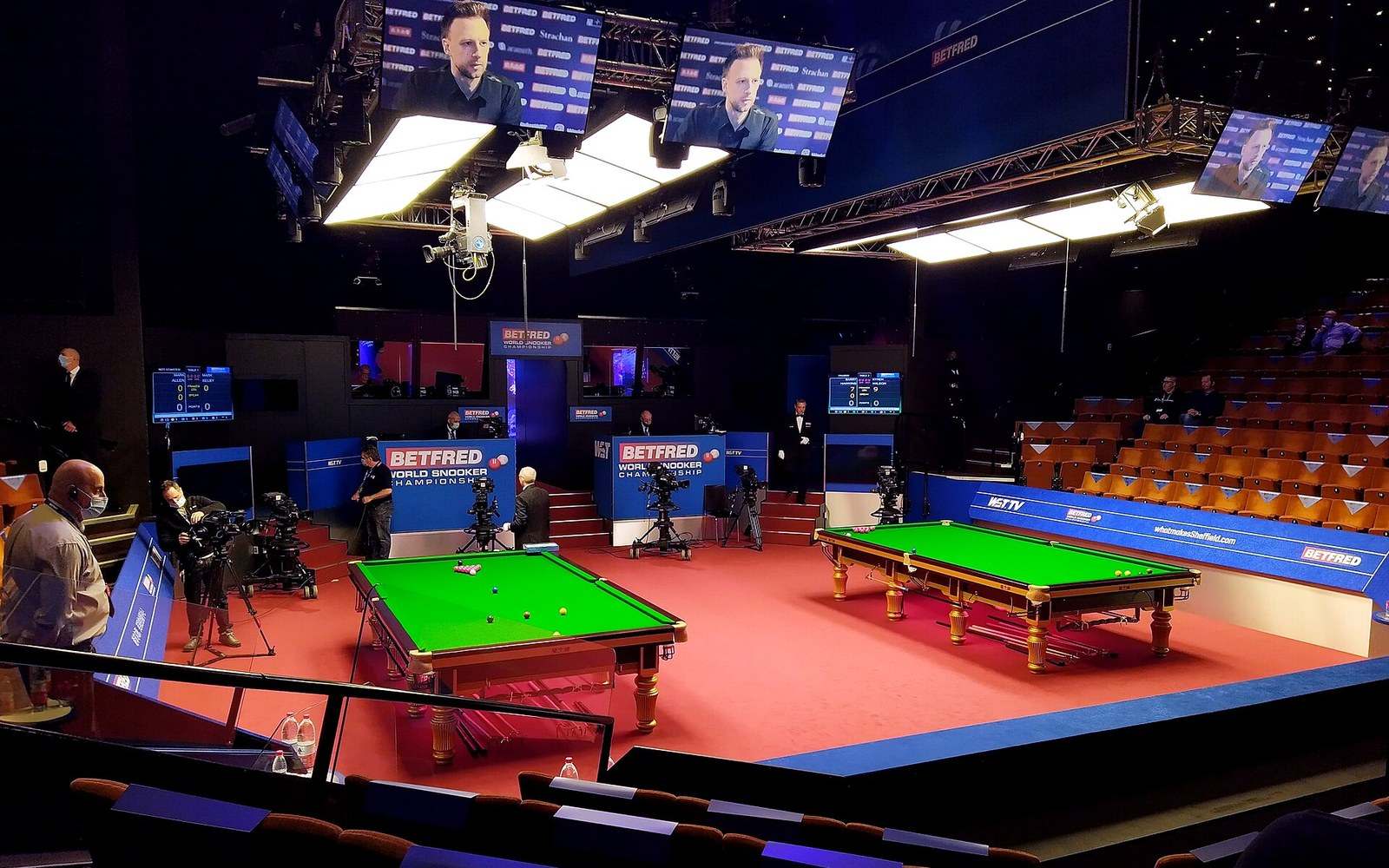
Two tables, a divider between them until the quarter-finals, and 980 seats around them.
Photo: 2021 World Snooker Championship table setup · Wikimedia CommonsA third reading is institutional. The two-year tour card system, as it operates now, was designed partly to keep the tour open to new entrants — Q School exists precisely to prevent the top of the ranking list from calcifying. But the card system only governs access; it cannot redistribute titles. The 1992 cohort stayed because they kept winning, and they kept winning partly because the ranking-event format, built around best-of frames played over multiple sessions across multiple days, rewards the kind of temperamental control that accumulates with experience rather than declining with age.
None of the three has formally announced retirement. Williams has said publicly, more than once, that he plays because he still enjoys it rather than from financial necessity. Higgins at fifty has spoken about motivation in terms that suggest he has not resolved the question. O'Sullivan's relationship with the calendar and the governing body has been documented extensively enough not to require summary here. What can be said with certainty is that a cohort which entered the professional game in 1992 is still, in 2025, requiring everyone else to qualify their own achievements against it.