The Championship Moved to a 980-Seat Theatre in 1977 and Never Left
The Crucible wasn't chosen for its prestige. It was chosen because it was available, affordable and the right size. The fact that it became irreplaceable is one of the sport's more elegant accidents.
The championship arrived in Sheffield in 1977 and has not moved since.
Photo: Balázs Gábor / PexelsFrom Wandering Years to a Converted Drama Theatre
The World Championship had no fixed home before 1977. Its wandering years included stints at the old Selly Park British Legion in Birmingham, halls in Manchester, and Middlesbrough Town Hall. The rooms varied, but too often they served the live audience poorly: awkward spaces, poor sight-lines, the players lost in the space around them. The atmosphere was professional in the corporate sense and flat in every other.
Mike Watterson, a snooker promoter and decent amateur player, visited the Crucible Theatre in Sheffield in the mid-1970s and identified what those earlier venues had missed. The Crucible had opened in 1971 as a thrust-stage theatre — a configuration in which the stage projects into the audience on three sides — and its design placed spectators physically close to whatever was happening on the floor. Watterson negotiated the booking, secured BBC television coverage, and the first Crucible championship was played in April 1977. John Spencer won it. The venue seated 980.
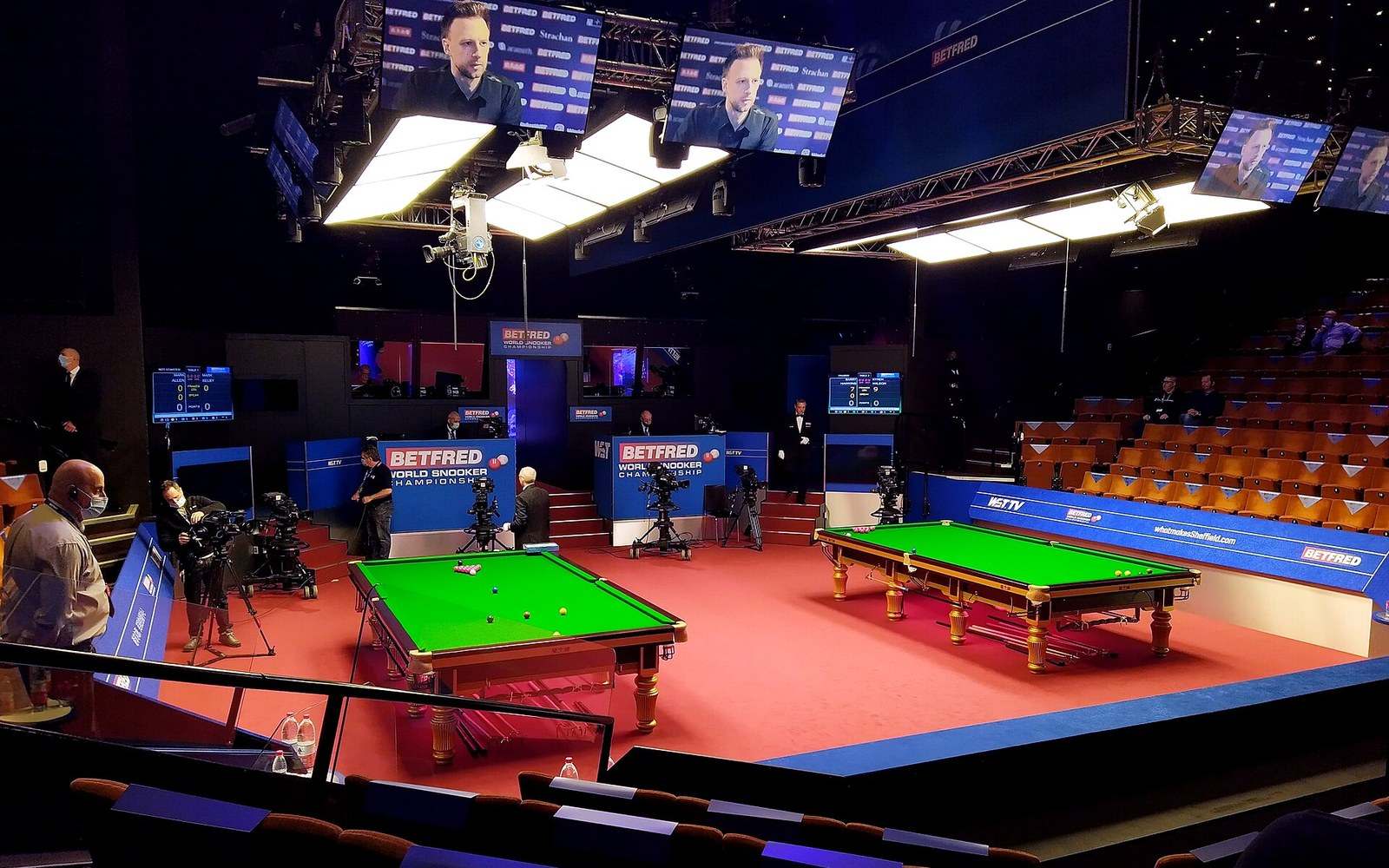
Two tables, a divider between them until the quarter-finals, and 980 seats around them.
Photo: 2021 World Snooker Championship table setup · Wikimedia CommonsSpencer's victory drew little attention compared to what happened next: the BBC's colour cameras, the green baize, the balls, and the architecture of proximity produced something the earlier venues had not. The crowd could hear the click of a pot. The referee's call carried. A missed black was visibly felt by the person sitting twelve rows back. Television picked all of this up.
Two Tables, One Divided Room
The operational logic of the Crucible adds a specific pressure that larger venues cannot replicate. The playing area is partitioned into two halves by a temporary screen, allowing simultaneous matches on separate tables during the earlier rounds. Sound bleeds through. A ripple of applause from the adjacent match interrupts concentration; a 147 attempt in one half of the room can barely be announced to the other. Players have described the awareness of a parallel contest running yards away as a unique and slightly surreal condition of competition.

A programme made to demonstrate colour television built the audience that filled the Crucible.
Photo: Tima Miroshnichenko / PexelsThe theatre's thrust configuration means that audience members sit not just in front of the action but around it. A player addressing the cue ball toward a corner pocket does so with spectators in peripheral vision at close range. That proximity is unforgiving in a way a stadium's removed seating is not. It also generates an intensity of atmosphere that has become, across nearly five decades, the defining sensory memory of the sport's biggest event. When Cliff Thorburn made the first 147 at the Crucible in 1983, the room's contained dimensions meant the silence before the final pink and black registered as almost physical.
For the tour's commercial purposes, 980 seats is a small number. The Saudi Arabia Snooker Masters, the Alexandra Palace events, the arenas that now host other ranking events accommodate multiples of that. Prize fund growth — driven significantly by Barry Hearn's restructuring of the tour from 2010 onwards — has made the economics of a sub-1,000-seat venue increasingly awkward to justify against what a purpose-built arena would generate in ticket revenue alone.
And yet the championship has not moved. Sheffield City Council, the WST, and the WPBSA have renewed and renegotiated the contract without ever seriously relocating the event to a larger venue. The public statements from the WPBSA about why — intimacy, tradition, the Crucible's singular character — are genuinely supported by the structure of the building. A championship played across seventeen days in a 980-seat theatre produces a pressure-cooker logic that three times the capacity would dilute. Whether the contract survives its current term, and whether the arithmetic eventually wins, remains the outstanding question. The building itself makes the strongest case for staying.