Thirty-Six Shots Without a Mistake, at Two in the Morning, in a Match He Lost
The first 147 at the Crucible came in the early hours, in a session Thorburn did not finish winning, and it changed what a maximum break meant.

Thirty-six shots without a mistake, at two in the morning, in a match he went on to lose.
Photo: Panta Singha / PexelsThe Night, the Match, the Opponent
Cliff Thorburn made the first maximum break in the World Championship on 23 April 1983, during his second-round match at the World Championship against Kirk Stevens. The time was approximately 12 minutes past midnight — some accounts place the final pot closer to half past — and the BBC cameras were still running. Thorburn was a Canadian professional, methodical and slow by reputation, already nicknamed "The Grinder" for an approach to the game that had won him the world title in 1980. Stevens was his compatriot, a fellow Canadian who in that same tournament year would reach the semi-finals. Neither of those facts determined what happened in that session's early hours.
The break began on a red that Thorburn nearly played safe on. He saw the angle, chose to attack, and committed. Thirty-six shots later — fifteen reds, fifteen blacks, then the six colours in sequence — he had scored 147 without a miss. The Crucible audience, by that point slightly reduced from its evening peak but far from gone, understood what they were watching before it was finished. The BBC commentary team confirmed it in real time. The crowd noise through the final colours was sustained in a way that audiences rarely managed inside the theatre's nine hundred and eighty seats.
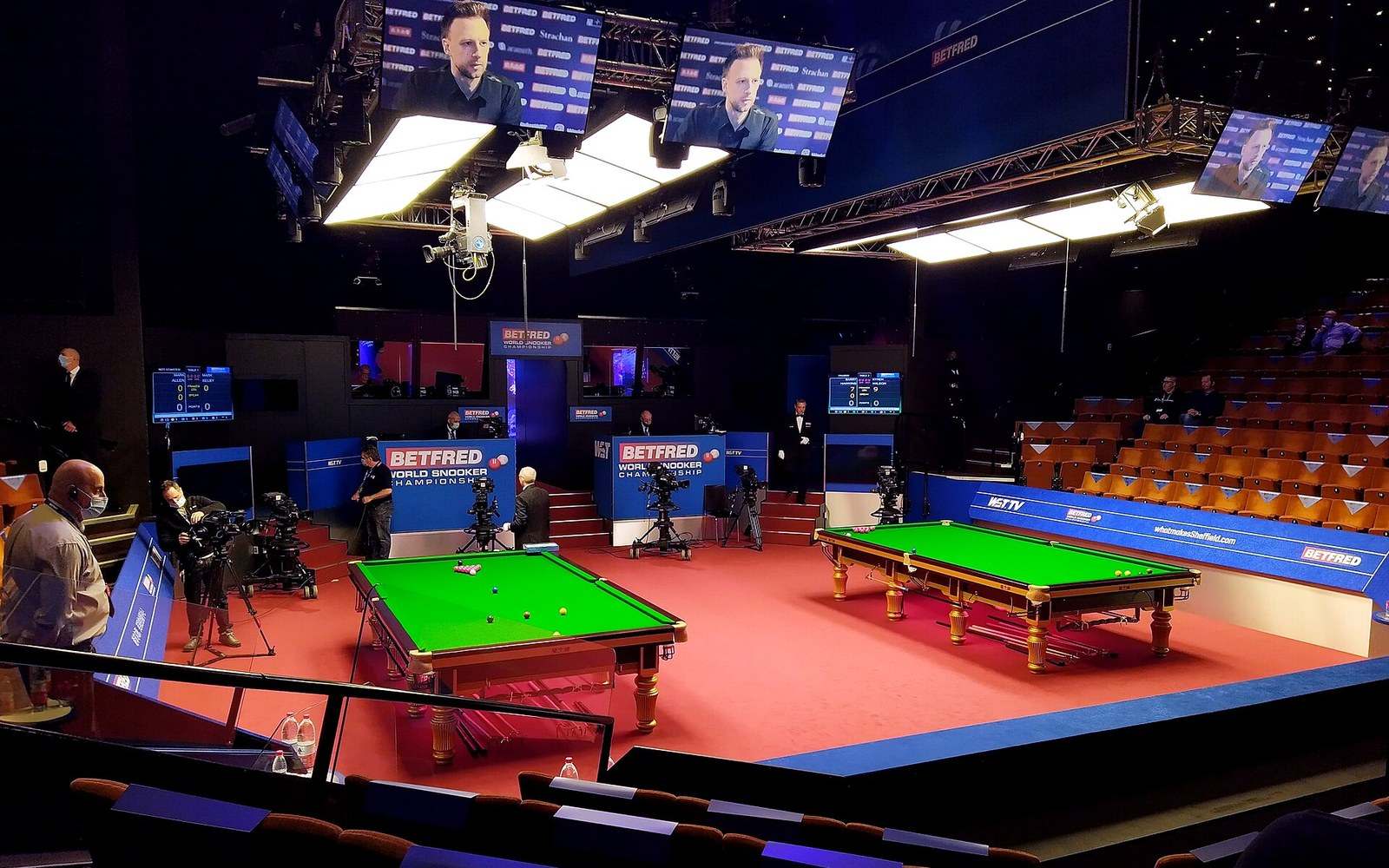
Two tables, a divider between them until the quarter-finals, and 980 seats around them.
Photo: 2021 World Snooker Championship table setup · Wikimedia CommonsThe maximum break as a scoring concept had existed in snooker's rulebook for decades before Thorburn's night. Kirk Stevens had scored 147 in a practice session — as had others — and the number was not mysterious to professional players. What it had never been before 1983 at the World Championship was a live, broadcast, tournament event: something a paying audience and a television audience witnessed at the moment of its completion, under competitive pressure, in the context of a match that counted toward a ranking. The distinction matters. Practice-room maximums are uncounted, unverified and numerous; this one was none of those things.
What the Break Did Not Do
Thorburn's 147 did not win him the match. He lost to Stevens across the full course of their encounter. This is worth stating plainly rather than footnoting, because the record itself has sometimes been recounted in ways that suggest it was a consolation to a winner. It was not. It was scored in a match Thorburn ultimately did not progress from, which means it belongs entirely to the category of great individual performances embedded in defeat — a category snooker produces more reliably than most sports.
Frame scores mid-session.
Photo: Element5 Digital / PexelsThe World Championship has been held at the Crucible Theatre in Sheffield since 1977, and the conditions of that venue have shaped how maximum breaks are remembered. The theatre's steep rake, the close proximity of the audience to the table, and the size of the room produce an atmosphere in which the tension of an extended break is physically present for the players. Thorburn later described the accumulating awareness of what was possible from around the pink stage onward — the crowd's held silence and then its noise, the growing weight of each shot. He was not a player known for flourishes or speed. The maximum he made was, in that sense, a perfect Thorburn production: precise, prolonged, and won only shot by shot.
The prize money attached to the break at the time was fifteen thousand pounds — a figure the tournament sponsors had placed on a maximum as a theoretical incentive, not expecting it to be claimed. Thorburn claimed it. The WPBSA has since adjusted how sponsored maximum prizes work, and the sums have varied by tournament and sponsor, but the principle of a separate award for a 147 in competition traces directly to that night.
The Thorburn maximum established one thing that has not changed: a competitive 147 is not a training achievement carried into a match but something that happens inside match conditions, under match pressure, in front of witnesses who cannot be substituted or removed. Every maximum scored in competition since April 1983 has been measured against that first one — the frame he won, inside the match he lost, in a season the Crucible has never quite been able to leave behind.